Agilest®

  • Certifications
    • PMI® PMP® Certification Prep Course
    • Scaled Agile (SAFe®) Certification
      • SAFe Agilist Certification (SA)
      • SAFe Product Owner / Product Manager Certification (POPM)
      • SAFe Scrum Master Certification (SSM)
      • SAFe For Government
      • SAFe Advanced Scrum Master Certification (SASM)
      • SAFe Practitioner Certification (SP)
      • SAFe DevOps Practitioner Certification (SDP)
      • SAFe Architect Certification (ARCH)
      • SAFe Agile Product Management Certification (APM)
      • SAFe Lean Portfolio Manager Certification (LPM)
      • SAFe Release Train Engineer Certification (RTE)
    • Kanban Certification
    • Agile HR Certification
    • Enterprise Agile Certification
      • Certified Agile Professional (CAP)
      • Agile Team Coach Certification (ATC)
      • Agile DevOps Management (DOM)
      • Agile Design Thinking Product Management (APM)
      • Certified Team Scrumban (CTS)
  • Training
    • Training Schedule
    • PMI® PMP® Certification Training
    • Scaled Agile (SAFe®) Training
    • Agile HR Training
    • Certified Agile Professional (CAP)
    • Agile Team Coach Certification (ATC)
    • Agile DevOps Management (DOM)
    • Agile Design Thinking Product Management (APM)
    • Agile Architect Leadership Training
    • Certified Core Kanban Training
    • Lean Kanban Certification Training
  • Transformation
    • Agile Transformations and the Role of Distributed Leadership
    • Enterprise Agile Transformation and TargetProcess
  • Resources
    • Podcast
    • What is Agile?
      • Agile Project Management
      • Agile Methodology
      • Agile Scrum
      • Scaled Agile
    • Agile Glossary
  • Contact
  • About Us

Agile Software Engineering

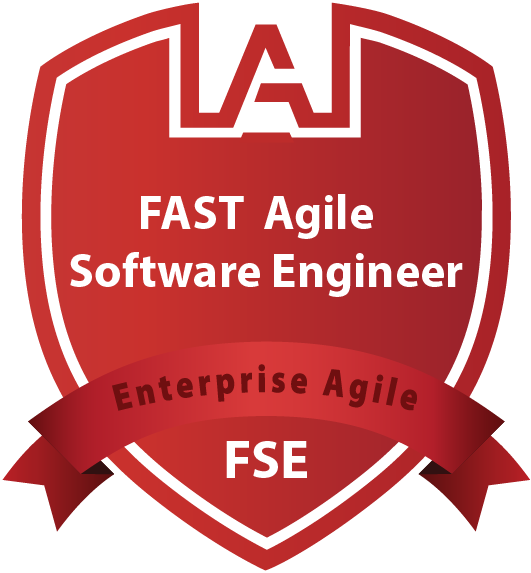
with FSE FAST Agile Software Engineer Certification

This training equips participants with specialized Agile software engineering skills, covering CI/CD, version control, architectural decisions, AI usage, and microservices management, enhanced by practical exercises and competitive gamification for a comprehensive and engaging learning experience.

  • Live Online
  • In-Person
  • Certification Included
  • 16  Hours (2 Days)
Get Certified
Certify My Team

    Request Private Training

    Thank you for your interest in AGILEST® training and services! We will be in contact with you shortly. For immediate assistance, you can call us at: (813) 669-2423

    First Name

    Last Name

    What training topic are you interested in?

    What is your geographic location?

    How would you like us to deliver this training?

    What is the date range when you want the training?

    How many participants are expected to receive the training?

    What is the name of your company?

    What is your email address?

    What is your phone number? (Please include country code)

    Comments

    We've Certified 

    23,000+ Professionals

    Since 2013

    We've Certified 

    13,000+ Professionals

    Since 2013

    Trusted By

    20,000+

    Companies Like

    About the Course

    Certification:

    FSE FAST Agile Software Engineer 

    This training covers those aspects of development that are specific to Software Engineering in an Agile environment including foundational Agile principles and essential practices like CI/CD and version control, architectural decisions involving monoliths vs. microservices and cloud transitions. The course also delves into advanced topics such as the use of AI in development and microservices dependency management, offering hands-on exercises and competitive gamification to ensure an engaging learning experience. This prepares participants to effectively implement Agile software engineering techniques in their work environments, driving personal and organizational advancement. 

    What Will I Learn?

    • Introduction to Agile Principles for Software Engineering
    • Foundational Practices: Continuous Integration and Continuous Delivery (CI/CD)

    • Version Control Strategies

    • Architectural Patterns: Monolith vs. Microservices

    • Transitioning to Cloud Environments

    • Advanced Development Practices with AI

    • Security Considerations with AI Tools

    • Dependency Management in Microservices

    Module 1: Introduction to Agile Principles for Software Engineering

    Objective: Understand foundational Agile principles and their application in software engineering.

    • Content: Discussion on adaptability, iterative development, and continuous improvement. 
    • Exercise: Participants analyze case studies to identify Agile principles in action within different software projects. 

    Module 2: Foundational Practices: Continuous Integration and Continuous Delivery (CI/CD)

    Objective: Master the automation of integration and deployment to support Agile operations.

    • Content: Detailed walkthrough of setting up CI/CD pipelines using tools like Jenkins or GitLab. 
    • Exercise: Hands-on workshop where participants set up a basic CI/CD pipeline for a sample project.


    Module 3: Version Control Strategies

    Objective: Explore effective version control techniques essential for Agile environments. 

    • Content: Best practices for branching and merging using Git.
    • Exercise: Simulated team exercise to manage a project using Git, focusing on handling merge conflicts and feature branching. 


    Module 4: Architectural Patterns: Monolith vs. Microservices

    Objective: Analyze the trade-offs between monolithic and microservices architectures. 

    • Content: Pros and cons discussion, real-world application scenarios.
    • Exercise: Group activity to redesign a monolithic application to microservices based on given requirements.


    Module 5: Transitioning to Cloud Environments

    Objective: Discuss strategic considerations for effectively moving architectures to the cloud. 

    • Content: Cloud service models, migration strategies, and cost-effective scaling. 
    • Exercise: Cloud migration strategy game where teams must plan and execute the transition of an application to the cloud under budget constraints.


    Module 6: Advanced Development Practices with AI

    Objective: Implement AI tools in software development to enhance efficiency. 

    • Content: Use of AI for code generation, testing, and refactoring. 
    • Exercise: Participants use an AI coding assistant to generate test cases and refactor an existing codebase.


    Module 7: Security Considerations with AI Tools

    Objective: Address the security implications of using AI in development. 

    • Content: Gating mechanisms for LLMs, data privacy practices. 
    • Exercise: Scenario-based role play on implementing security measures with AI tools in a development project.


    Module 8: Dependency Management in Microservices 

    Objective: Manage dependencies and ensure effective service interactions in a microservices architecture. 

    • Content: Strategies for minimizing coupling and maintaining service integrity. 
    • Exercise: Interactive group challenge to organize and optimize a network of microservices for a hypothetical large-scale application.

    These modules are designed to impart knowledge and to apply and reinforce learning through practical, hands-on experiences and competitive elements that make the learning process effective and engaging.


    Agile Training Schedule

     
    Course Title
    Course Location
    Course Dates
    Course Details
    13
    April
    SAFe Lean Portfolio Management LPM
    Online, Central Time (CT)
    April 13 @ 9:00 am - April 14 @ 5:00 pm
    Course Details
    View More

    or

    request corporate training

      Request Private Training

      Thank you for your interest in AGILEST® training and services! We will be in contact with you shortly. For immediate assistance, you can call us at: (813) 669-2423

      First Name

      Last Name

      What training topic are you interested in?

      What is your geographic location?

      How would you like us to deliver this training?

      What is the date range when you want the training?

      How many participants are expected to receive the training?

      What is the name of your company?

      What is your email address?

      What is your phone number? (Please include country code)

      Comments

      Expanded Agile Software Engineering with FSE (FAST Agile Software Engineering) certification training description

      Introduction to Agile Principles for Software Engineering 

      Agile software engineering revolutionizes traditional development methodologies through adaptability, iterative development, and continuous improvement. These principles ensure software remains relevant by responding swiftly to market or technological changes, encouraging short development cycles for immediate product enhancements, and fostering a culture of ongoing processes and product refinement. 

      Foundational Practices for Agile Software Engineering 

      Continuous Integration and Continuous Delivery (CI/CD): Learn to automate integration and deployment processes, enhancing productivity and ensuring consistent, quality delivery. Understand the nuances of building a robust CI/CD pipeline that supports Agile operations. 

      Version Control Strategies: Master effective version control practices critical for managing collaborative code changes, supporting frequent updates, and maintaining a coherent project history in Agile settings. 

      Architectural Patterns for Agile Software Engineering 

      Monolith vs. Microservices: Explore the trade-offs between these architectures to determine the best fit for project needs, focusing on scalability, manageability, and development velocity. 

      Transitioning to Cloud Environments: Discuss strategic considerations for cloud integration, emphasizing performance, scalability, cost-effectiveness, and the architectural decisions that influence these factors. 

      Advanced Development Practices 

      AI in Software Development: Discover how AI can automate coding, testing, and refactoring, aligning with Agile methodologies to accelerate development cycles. 

      Security Considerations with AI Tools: Tackle the security challenges presented by AI in development, focusing on implementing gating mechanisms for LLMs to safeguard sensitive data. 

      Code Refactoring 

      Delve into code refactoring techniques that enhance maintainability, reduce technical debt, and improve software quality, crucial for adapting to evolving Agile project requirements. 

      Dependency Management in Microservices 

      Address the intricacies of managing dependencies in microservices, emphasizing strategies to minimize coupling and ensure effective service interactions.

      Get Certified
      Certify My Team

        Request Private Training

        Thank you for your interest in AGILEST® training and services! We will be in contact with you shortly. For immediate assistance, you can call us at: (813) 669-2423

        First Name

        Last Name

        What training topic are you interested in?

        What is your geographic location?

        How would you like us to deliver this training?

        What is the date range when you want the training?

        How many participants are expected to receive the training?

        What is the name of your company?

        What is your email address?

        What is your phone number? (Please include country code)

        Comments


        Copyright © 2026 Agilest LLC.  AGILEST® is a registered trademark of AGILEST® LLC.
        ContactPrivacyTerms of Use
        7ads6x98y